
News, views and advertising of the Grand Coulee Dam Area


News, views and advertising of the Grand Coulee Dam Area
Just in time for America's 250th
As the nation celebrates 250 years after the signing of the Declaration of Independence, the Grand Coulee Dam area is celebrating too, and at the Festival of America that means three days with kids' games, fun, a beer garden, and vendors, and two afternoons and evenings with live music, then the culmination of the festival with fireworks off the top of Grand Coulee Dam on July 4th. See our guide to the festival in this issue's second section.
The Grand Coulee Dam Area Chamber of Commerce, which puts on the event at the foot of Grand Coulee Dam, will hold a unique ribbon cutting event for a special part of the dam project. It hasn't been run since 1952, and it's so obscure it's thought likely that most of the local population today has not known of its existence until recently.
"The silly part about it is I've talked to people that have lived here for 74 years, never seen it," Councilmember Keith St. Jeor told the Coulee Dam Town Council last week.
St. Jeor, a Power Systems Control Craftsman at dam, got the go-ahead just over a month ago to get the Model Dam ready for a public demonstration for this week. "I really got to give credit to [Project Manager Supervisor] Stephanie Utter," he said later. "She could have shut this down in a heartbeat."
Instead, a key research project, an engineering feat in itself from the World War 2 era, is visible again.
The video above was added after the opening ceremony on July 2, 2026.
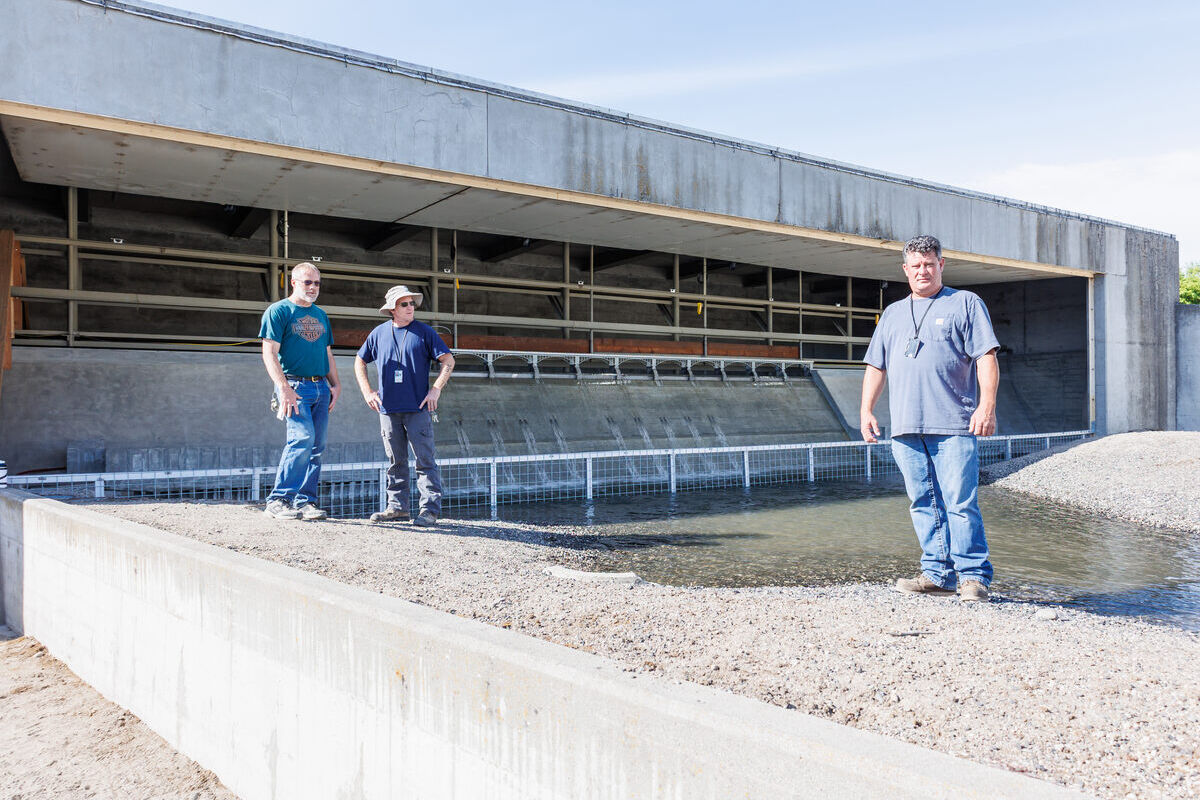
We're not talking a table-top model, St. Jeor told the council. It resides inside a building you may have driven by for years, perhaps wondering what it was. The parking lot that overlooks Lake Roosevelt just above the dam, in 1943 was called the Vista Park.
The short building there still holds the Model Dam, and now it works. It's 1/60th the size of the real one, and it's built to scale right down to a mile or so of riverbank downstream. Engineers studying erosion patterns even tested those rocks and sands to see what worked best under different river flow circumstances.
During a sneak peek June 25, the small river model was flowing downstream, after topping the spillway with its drum gates lowered, flowing through the generators in the Left and Right Powerhouses, and flowing out the "river outlets."
The engineers' studies began in 1943, and tests ran from June 1943 through December 1944, according to a 1945 Bureau of Reclamation hydraulic laboratory report. The text says the model included features such as drum gate seats, crest piers, spillway sections, training walls, model powerhouses, and related flow-control features, such as the same number of generators through which water could flow from the left and right powerhouses. There was once even a bridge downstream, but only the pilings in the riverbed are left, scale replicas of those under that same bridge we drive over now.
The engineer's report was found in a digital archive at Washington State University, St. Jeor said.
That flow last week, which came from reservoirs behind the spillway and below the model totaling over 300,000 gallons of capacity, was controlled by valves and cranks back in the '40s. In getting the model ready for its 2026 debut, workers were proud to have added a modern variable control on the big pump that supplies the pressure to copy the pressure at scale of a full flowing Columbia River.
Reclamation engineers wrote in 1945 that rocks could be heard striking one another in high-velocity eddies below the dam, raising fears that sand, gravel and construction debris had been carried into the spillway bucket, where their movement might abrade the concrete. "These conditions were cause for apprehension," the report said, prompting studies into how the bucket could be inspected.
The "spillway bucket" is a curved-up lip across the bottom of the spillway that directs the energy of the spill upward and away from the structure and changing the flow to a less destructive nature.
Reclamation engineers used their mini dam to watch currents scour gravel and other material around the ends of the dam's training walls and spillway bucket, then tested possible fixes. Photos in the report show simulated high flows - including flows listed at 787,000 cubic feet per second [nearly 5.9 million gallons of water every second] - eating into model riverbed material, then changing after concrete blocks or rock protection were added.
Another part of their work involved mocking up a model "caisson" that could be floated into place over that curved lip "spillway bucket" to inspect and repair it. The remnants of such a model are still sitting under cover in a Reclamation boneyard of sorts, near an old, giant concrete funnel.
A caisson storage area can still be seen downstream from the right powerhouse at the model. St. Jeor would like to see it hold that model caisson, but perhaps that's a project for another year.
Reader Comments(0)